FULL VIDEO AT THE END OF THE POST

A Lakefront Dispute in Indianapolis
Mr. Coward brought a case against Mr. Smith.
The dispute centered on fishing rights on a lake in Indianapolis, Indiana.
Mr. Smith owned a home on this lake.
He believed the lake was entirely private property.
Mr. Coward, however, believed he had a right to fish there.
The Plaintiff's Claim to Fish
Mr. Coward stated he started fishing on the lake in April.
He had not fished there before because he thought it was private.
His understanding changed after receiving a neighborhood association newsletter.
This newsletter indicated the lake was no longer private.
Mr. Coward claimed he was fishing from the bank, not from a boat.
He accessed the bank through property deeded to the park department.

Early Encounters with the Sheriff
Mr. Coward testified that he fished on the lake two or three times.
Each time, the sheriff arrived and told him to leave.
Mr. Coward tried to explain to the sheriff that he had a right to fish.
He mentioned the property had been deeded to the park department.
The sheriff, however, would not listen and made them leave.

The Confrontation with Mr. Smith
After these encounters with the sheriff, Mr. Coward returned to fish again.
He was fishing with a friend.
Mr. Smith then approached them in his boat.
Mr. Coward stated that Mr. Smith cursed at them.
Mr. Smith told them to get off the lake.
He threatened them, saying he would come through the woods with a piece of wood.
Mr. Smith allegedly said he would "knock us in the head."
Mr. Smith then used his boat to pull their fishing lines into the water.
Mr. Coward described Mr. Smith as saying, "I'm the baddest thing here."
Mr. Smith's View of Lake Ownership
Mr. Smith confirmed he owned a home on the lake.
He stated there were about 35 homes on the lake, soon to be 38.
He maintained that the lake was private.
Mr. Smith cited court statements filed by the court and the builder as proof.
He firmly believed it was a private lake.

The Conflicting Newsletters
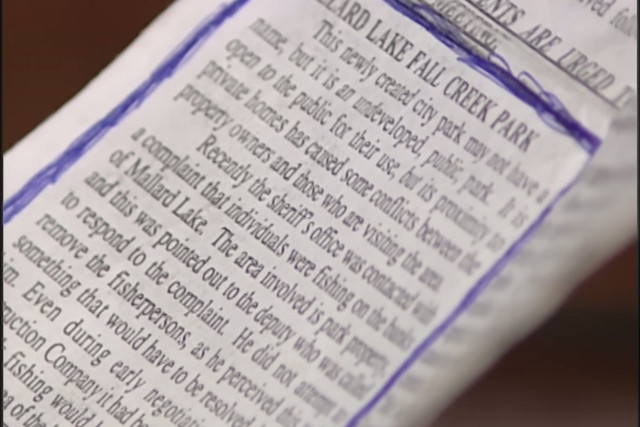
Judge Judy asked to see the newsletter Mr. Coward mentioned.
Mr. Coward provided a newsletter from his neighborhood association.
Judge Judy read from the newsletter.
It stated that the original agreement for a private park was no longer in effect.
The newsletter claimed the property had been deeded to the city.
It concluded that the public had every right to be there.
Mr. Smith denied ever seeing this particular newsletter.
He insisted it had nothing to do with Mallard Lake, his lake.
Judge Judy clarified that the newsletter specifically mentioned Mallard Lake.
Mr. Coward's Persistence
Judge Judy questioned Mr. Coward about his repeated returns.
She noted he was told by the sheriff to leave about three times.
Despite these warnings, Mr. Coward continued to come back.
Judge Judy called this "not a smart thing to do."
Mr. Coward explained that he returned after receiving a second newsletter.
This second newsletter also supported his belief in public access.
The Second Newsletter's Details
Judge Judy read from the second newsletter.
This one was from the Divine Neighborhood Association.
It stated that bank fishing would be permitted from non-residential areas of the lake.
Fishing from a boat, however, would be prohibited.
The newsletter further stated that bank fishing was permitted because the park site had been deeded to the city.
Judge Judy acknowledged that Mr. Coward had reason to believe he could fish there.
This belief was based on the information from his neighborhood association.
Mr. Smith's Evidence of Private Ownership
Mr. Smith presented his evidence to Judge Judy.